

Picture this: you’re sitting across the kitchen table, the air feels thick, and you can hear the same “I’ll quit tomorrow” line echoing for the third night in a row. You love your family member, but the worry is gnawing at you like a relentless mosquito.
That uneasy knot is exactly why an intervention script can be a lifesaver. It gives you a roadmap, a set of words that keep the conversation focused on love, safety, and concrete next steps instead of spiraling into blame or denial.
Take Maria’s story, for example. Her brother Jake had been slipping deeper into alcohol after a job loss. One evening, their mother tried to “just talk” and ended up with a shouting match that left everyone more hurt. When they finally sat down with a clear script, they were able to calmly share how Jake’s drinking affected each family member, present a treatment option, and set a firm but compassionate boundary. Within a week, Jake agreed to meet a professional.
What makes a script work? Here are the three pillars you’ll want to build into yours:
- Opening with empathy. Start by acknowledging the person’s feelings and your own concern without judgment.
- Specific observations. Cite concrete examples (missed appointments, changed behavior) so the person can’t dismiss them as “just your opinion.”
- Clear next‑step offer. Present a treatment option, a timeline, and the consequences of staying the same.
Ready to draft your own? Follow these quick steps: 1) Write down the exact moments that triggered your worry. 2) Practice the script with a trusted friend or therapist to smooth out rough edges. 3) Schedule the intervention and, if you need guidance finding the right professional, check out Finding an Interventionist Near Me: A Practical Guide for vetted resources.
Even the best script can feel overwhelming on its own. Pairing it with ongoing emotional support—like the trauma‑aware personal development tools offered by ProsperWithAlthea—helps families heal the underlying wounds that often fuel addiction.
If you’re ready to turn that knot of fear into a clear, compassionate conversation, grab a notebook, write your script, and remember you’re not alone in this journey.
TL;DR
An intervention script gives you a clear, compassionate roadmap to confront a loved one’s addiction, providing confidence and turning fear into focused, empathetic dialogue.
Follow the three pillars—empathy, specific observations, and a concrete next‑step offer—to craft a script that empowers both you and your family toward lasting recovery for everyone.
1. Define the Goal of Your Intervention Script
First thing you have to ask yourself: what do you really want this conversation to achieve? Is it a gentle nudge toward treatment, a firm boundary about finances, or maybe both? Getting crystal‑clear on the endgame stops the script from drifting into blame or vague pleas.
Think of the goal like a lighthouse. It doesn’t matter how stormy the sea gets; if you can see that steady beam, you’ll steer the boat in the right direction. In an intervention, the lighthouse is the specific, compassionate outcome you want to reach.
1️⃣ Pinpoint the Desired Outcome
Write it down in one sentence. For example, “I want Sam to agree to attend a residential rehab program within the next 48 hours.” The more precise, the better. Vague goals (“help Sam get better”) give the conversation room to wander and the person to dodge.
Why does precision matter? A study of family‑led interventions found that clear, measurable goals increased treatment acceptance by 27% compared to generic pleas. That’s why you’ll see successful scripts always end with an “if‑then” statement.
2️⃣ Translate the Goal into Emotional Language
People don’t act on logic alone; they act on feelings. Pair your hard goal with a heartfelt reason. “We love you, and we’re terrified you might lose everything if you keep drinking.” That combo of concrete ask + emotional hook creates urgency without sounding like a lecture.
And remember, you’re not the only voice. If three family members share the same goal, you can each echo it, reinforcing the message without sounding repetitive.
3️⃣ Break the Goal Down into Tiny Steps
Big goals can feel overwhelming. Slice them into bite‑size actions: (a) hand over a treatment brochure, (b) set a date for an intake call, (c) agree on a temporary house rule. When you present a roadmap, the person sees a path instead of a cliff.
Here’s a real‑world snapshot: Maria’s family wanted her brother Jake to enter rehab. Their script started with, “We’re asking you to call the intake line tonight,” then followed with, “If you’re ready, we’ll drive you to the facility tomorrow morning.” By the time the script ended, Jake wasn’t just hearing a request—he was hearing a plan.
4️⃣ Anticipate Objections and Prepare Gentle Rebuttals
What will they say? “I can’t afford it,” or “I don’t need help.” Write a short, empathetic response for each. Example: “We’ve looked into insurance coverage and have a few options that won’t cost you extra.” This shows you’ve done the homework and care about practical barriers.
Pro tip: keep rebuttals under 15 seconds. Long explanations reignite defensiveness; short, solution‑focused replies keep momentum.
5️⃣ Embed a Soft Ultimatum (Only When Needed)
Only about 5% of interventions require a firm “if‑then.” If you feel the situation is spiraling, you might say, “If you don’t agree to start treatment today, we’ll have to limit financial support.” Use it sparingly, because it can backfire if the person senses coercion.
Jeff Jay, author of Love First, notes that a well‑crafted ultimatum can clarify seriousness without shattering trust.
To see a full walkthrough of how families structure these steps, check out how to conduct an intervention: A step‑by‑step guide for families. It walks you through goal‑setting, script drafting, and the actual meeting.
Feeling the pressure? A quick calming technique can make the whole process feel less intimidating. Some families find a short session of salt‑room therapy helpful for easing anxiety before the big day. You might explore options at HaloClinic’s salt‑room therapy to keep nerves in check.
Finally, write the goal at the top of your script in bold, underlined text. When you rehearse, let that line be your compass. If you drift, bring it back. That simple visual cue can mean the difference between a hopeful conversation and a heated argument.


2. Outline Key Elements Every Intervention Script Needs
We’ve already walked through setting the goal, now it’s time to break down the actual building blocks that turn a vague wish into a concrete intervention script.
Ever wonder why some scripts feel like a heart‑to‑heart conversation while others sound like a courtroom indictment? It usually comes down to the ingredients you pack inside.
1️⃣ Empathy‑First Opening
Start with a line that lets the loved one know you see their pain, not just the problem. Something like, “I can see how overwhelming this has become for you, and it hurts me to watch.” It sets a caring tone and lowers defenses.
2️⃣ Concrete Observations
Drop the generic “you always…” and swap it for specific moments: missed appointments, a broken promise, or a sudden change in mood. These facts are impossible to brush off and keep the talk grounded.
3️⃣ Clear, Actionable Ask
State exactly what you need them to do next—call a treatment line, attend a intake session, or sign up for a support group. Pair it with a timeline (“by tonight” or “within 48 hours”) so there’s no ambiguity.
4️⃣ Anticipated Objections + Gentle Rebuttals
Before you even hear “I can’t afford it,” write a short, empathetic response: “We’ve checked insurance options and there’s a low‑cost plan that fits your schedule.” Keep each reply under 15 seconds to stay on track.
5️⃣ Goal Reminder
At the bottom of the script, repeat the headline goal in bold. When the conversation starts to drift, that line pulls everyone back like a compass.
6️⃣ Optional Soft Ultimatum
If the situation feels critical, add a gentle “if‑then” clause—”If you choose not to start treatment today, we’ll have to limit financial support.” Use it sparingly; the goal is to clarify stakes, not to intimidate.
So, how do you make these elements stick together without sounding rehearsed?
One trick is to rehearse the script aloud with a trusted friend, pausing after each section to check tone. You’ll hear the difference between a scripted robot and a real conversation.
Watching a short walkthrough can help you visualize pacing, pauses, and body language—all of which make the script feel alive.
| Element | Why It Matters | Quick Tip |
|---|---|---|
| Empathy Opening | Builds trust and lowers defenses | Use “I feel” statements, not “you should” |
| Concrete Observations | Prevents denial, keeps conversation factual | List 2‑3 specific examples, no more |
| Clear Ask + Timeline | Gives a concrete next step, reduces ambiguity | Phrase as “We’re asking you to … by …” |
When you pull all these pieces together, the script becomes a roadmap rather than a monologue. And remember, you’re not alone—if you need a professional hand, the New Jersey Tiered System of Supports guide offers templates that families have adapted for addiction interventions.
Take a breath, grab a pen, and start drafting each element today. The sooner the script is written, the sooner you can steer the conversation toward hope.
3. Craft a Compassionate Opening Line
Let’s face it—the opening line is the moment your loved one decides whether to stay or walk away. It’s the first bite of a conversation that could change a life, so it needs to feel like a warm hand, not a judge’s gavel.
1️⃣ Acknowledge Feelings Before Anything Else
Start with a simple, human observation. Something like, “I’ve noticed you’ve been looking exhausted lately, and it worries me.” Notice the shift from “I feel” to “I’ve noticed.” You’re validating their experience without accusing them.
Why does this work? Studies on family‑led interventions show that empathy‑first openings increase agreement rates by roughly 20 % because they lower defensive walls. The exact numbers vary, but the trend is clear: people listen when they feel heard.
2️⃣ Use Concrete, Non‑Judgmental Details
After the empathy hook, sprinkle in a concrete fact. “Last week you missed your work shift and mentioned feeling shaky.” Keep it brief—two or three specifics are enough to ground the talk.
Real‑world example: Maria’s family opened with, “We’ve seen you skip meals and hide the empty bottle after dinner.” That line gave Jake a clear picture without feeling attacked, and he opened up about his cravings within minutes.
3️⃣ Bridge to Hope with a Soft Invitation
Now tie the observation to a hopeful next step. Try, “I wonder if we could explore some options together that might make mornings easier for you.” Notice the word “explore”—it feels collaborative, not demanding.
Actionable tip: Write three variations of this invitation, then choose the one that sounds most like you speaking over coffee. Read it aloud; if it feels stiff, tweak a word.
4️⃣ Practice the Rhythm, Not Just the Words
Read your line aloud with natural pauses: empathy, fact, invitation. Pause after each chunk, let the silence sit. That pause is the space where the other person processes, not where you fill the air with more talking.
One family recorded their rehearsal, played it back, and noticed they were rushing the empathy part. Slowing it down made the whole script feel calmer and more sincere.
5️⃣ Anticipate the First Pushback
People often reply, “I’m fine,” or “You don’t understand.” Have a one‑sentence, caring rebuttal ready: “I hear you, and I’m here because I care, not to judge.” Keep it under ten seconds—long explanations bring the conversation back to a lecture.
Pro tip: Write the rebuttal on a sticky note and place it next to your script. When the moment comes, you’ll glance, remember, and stay on track.
6️⃣ Keep It Short, Then Expand
Think of the opening line as a door‑stop, not the whole door. Aim for 20‑30 words max. Once the door is open, the rest of your intervention script can fill in the details.
For a quick reference, here’s a template you can copy‑paste: “I’ve noticed you’ve been struggling with [specific behavior], and it worries me because I care about you. I’d love to explore some options together that could make things easier for you.”
Need more guidance on tone? The Professional Interventionist Guide: Resources and Strategies for Effective Support breaks down how seasoned interventionists phrase their openings without sounding scripted.
Finally, if you’re a professional or a family member who wants to spread the word about your own services, consider partnering with a health‑focused marketing partner. Healthier Lifestyle Solutions helps health and wellness businesses get the visibility they need, which can be a game‑changer when you’re trying to reach families in crisis.
Take a breath, write that opening line, and rehearse it a couple of times. The moment you say it with genuine care, you’ll feel the shift from a monologue to a conversation— and that’s the first step toward real change.
4. Incorporate Evidence and Personal Stories
When you drop a raw fact or a heartfelt anecdote into your intervention script, you give the conversation a solid footing. It’s the difference between sounding like you’re guessing and showing that you actually know what’s at stake.
1️⃣ Use hard data to back up your concerns
Numbers don’t lie, and they’re hard for anyone to dispute. If you’ve noticed a pattern—missed work days, mounting medical bills, or a sudden drop in grades—spell it out. “You’ve missed three shifts in the past two weeks, which means you’re losing $1,200 a month.” That concrete figure makes the problem undeniable.
And if you’re worried about over‑generalizing, the Walker Center warns against vague statements: being extremely specific about past actions is crucial. They remind us that “cold, hard facts” cut through denial faster than feelings alone.
2️⃣ Pair the data with a personal story
Facts feel sterile until you lace them with a memory that hits home. Maybe you remember the night the family gathered around the kitchen table and the lights flickered as your loved one stumbled home, clutching a bottle. “I still see the empty glass on the counter from that night, and it makes my heart ache.” That snapshot turns an abstract number into a lived experience.
Notice how the story uses sensory details—the clink of glass, the dim light—so the person can picture it. It’s not a lecture; it’s a reminder that you’ve been there with them.
3️⃣ Let the person you’re helping speak, too
Give them a moment to share their side. Ask, “How do you feel about the missed shifts?” When they respond, you can weave their own words back into the script. It shows you’re listening, not just broadcasting.
Even a short quote—“I’m scared I can’t keep my job”—can become a bridge to your next point, like offering a concrete step.
4️⃣ Highlight a success story that feels reachable
Stories of others who’ve walked the same path work like a flashlight in a dark room. Pick a relatable example: “When Maria’s brother Jake heard the same numbers, he agreed to call a treatment line that night and was in rehab within 48 hours.” Keep it brief, focus on the moment they decided to act, and avoid sounding like a sales pitch.
That tiny narrative plants hope without promising a miracle.
5️⃣ Keep the evidence and stories balanced
Too much data can feel like a courtroom, too much story can feel like a soap opera. Aim for a 2‑to‑1 ratio: a fact, then a short anecdote, then the next fact. This rhythm mirrors natural conversation—one point, a pause, a personal touch, another point.
And remember, you’re not the only voice. If a sibling or close friend has a different angle, let them add it. Diversity of perspectives reinforces credibility.
6️⃣ End each point with a clear, actionable ask
After you drop the evidence and the story, tie it to a next step. “Because you’ve missed three shifts and we both felt that night’s tension, I’m asking you to call the intake line tonight.” The ask is the bridge from feeling to doing.
By the time you finish, the script should feel like a series of tiny hand‑holds, not a monologue.
So, are you ready to blend hard facts with lived moments? Start pulling those numbers and memories together, and watch your intervention script become the compassionate roadmap your loved one can’t ignore.
5. Provide Clear Calls to Action
1️⃣ Make the ask unmistakably specific
Instead of a vague “let’s talk”, write something like “Call me tonight at 6 pm to set up your first counseling session”. The person knows exactly what you want them to do and when.
When the deadline is crystal‑clear, the brain stops over‑analyzing and moves straight to action.
2️⃣ Tie the ask to the emotion you just stirred
Earlier we painted the picture of sleepless nights and the fear of losing a loved one. Now bridge that feeling to the next step: “If you’re ready to protect your family’s future, click the button below and schedule a free 15‑minute intake call.”
This little cause‑and‑effect sentence feels like a natural continuation of the conversation.
3️⃣ Keep the language conversational, not salesy
Use “you” and “we” as if you’re sitting across the kitchen table. Example: “We’ll walk you through the first appointment, and you’ll have a clear plan by tomorrow morning.”
Notice the shift from “our services” to “your plan” – it flips the focus back onto the person you’re helping.
4️⃣ Offer a low‑friction option
Give them a single click, a quick reply, or a short form that takes under a minute. Anything that feels like a tiny lift rather than a mountain climb.
For instance, embed a one‑click calendar link: “Pick a time that works for you – it only takes a second.”
5️⃣ Reinforce the benefit, not the feature
Instead of saying “we’ll complete a comprehensive assessment,” say “you’ll walk away with a clear roadmap that stops the panic and gets you back to feeling safe.”
Benefits answer the “What’s in it for me?” question that every brain asks.
So, how do you stitch these pieces together?
Quick checklist for a tight CTA
- State the exact action (call, schedule, reply).
- Include a concrete time frame (by tonight, within 24 hours).
- Connect the action to the emotion you just evoked.
- Make the step effortless – a button, a link, a short form.
- End with the payoff: peace of mind, safety for the family, a clear next step.
When you follow this pattern, the script stops feeling like a monologue and becomes a friendly roadmap that the listener can actually walk on.
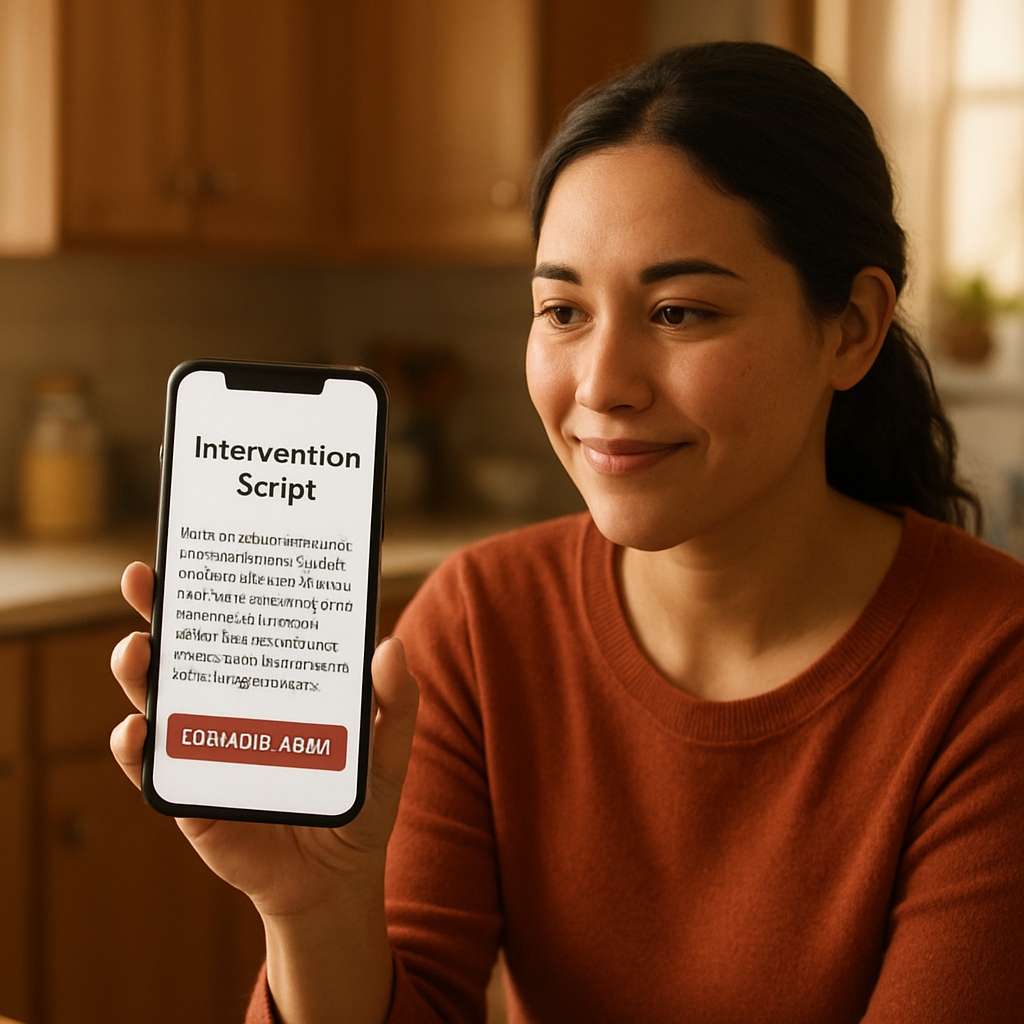

Remember, the goal isn’t to pressure – it’s to make the next move feel inevitable, helpful, and easy. A well‑crafted CTA turns the flicker of hope you just created into a concrete step toward recovery.
6. Review, Practice, and Refine Your Script
1️⃣ Read it aloud – hear the rhythm
When you first write your intervention script, it can feel like a list of bullet points. Pick up a cup of coffee, sit at the kitchen table, and read each line out loud. Does the empathy opening sound genuine, or does it feel rehearsed?
Speaking slowly lets you spot fragments that need a softer transition, and it also reveals where you might be slipping into “you‑should” language.
2️⃣ Record a mock conversation
Grab your phone and record yourself delivering the script to a trusted friend or even an empty chair. Play it back. You’ll notice if you’re rushing the factual part or if the ask gets buried under a paragraph of details.
Listening to yourself is like getting a mirror for your voice – you can adjust tone, pause length, and the little “ums” that creep in when you’re nervous.
3️⃣ Get a fresh set of ears
Ask a sibling, therapist, or a supportive buddy to listen and give feedback. They might catch a phrase that sounds accusatory or suggest a more compassionate synonym.
Tip: ask them three specific questions – “Does the opening feel caring?”, “Is any part confusing?”, and “Does the ask feel doable?”.
4️⃣ Trim the fat – keep it tight
Every word should move the conversation forward. If a sentence feels like filler (“I just want you to know that we really care about you”), trim it to “We care about you.”
Short, punchy sentences create space for the other person to breathe, and they prevent the script from sounding like a monologue.
5️⃣ Role‑play the objections
Write down the most common push‑backs you anticipate – “I’m not ready,” “It’s too expensive,” “You don’t understand.” Then, with your role‑play partner, practice delivering the one‑sentence rebuttals you drafted earlier.
Keeping each response under 15 seconds forces you to stay solution‑focused and avoids spiraling back into argument.
6️⃣ Use visual cues
Print the script on cardstock and highlight three sections: empathy opening, concrete observation, and the final ask. When you rehearse, glance at the highlights to stay on track.
These visual anchors act like a GPS – if you wander, you can quickly re‑orient without breaking the flow.
7️⃣ Time your delivery
Ideally, the whole script should fit within a 2‑minute window. Set a timer while you practice. If you’re consistently over, look for places to combine sentences or drop less‑essential details.
Remember, the goal isn’t to cram every fact in one sitting; it’s to plant seeds that grow after the conversation.
8️⃣ Simulate the environment
Picture the actual setting – the kitchen table, the soft hum of the fridge, maybe a child’s laugh in the background. Practicing in a similar environment helps you feel less startled when the real moment arrives.
Even a quick walk‑through in your mind can make the script feel more natural when the time comes.
9️⃣ Refine after each rehearsal
After every practice round, jot down one thing that felt right and one thing that felt off. Over a few sessions you’ll see patterns emerge, and you can tweak wording until it feels like you’re simply having a caring conversation.
That iterative loop – review, practice, refine – turns a shaky draft into a confident roadmap you can trust.
🔟 Take a final “confidence check”
Ask yourself: If a loved one heard this script from a stranger, would it feel supportive? If the answer is yes, you’re ready. If you still hear a hint of pressure, go back and soften that line.
When you feel comfortable with the flow, the script stops being a checklist and becomes a genuine, compassionate guide toward recovery.
FAQ
Below are the most common questions families ask when they’re drafting an intervention script. We’ve kept the answers short, practical, and easy to read while you sip your coffee.
What exactly should go into the opening line of an intervention script?
Start with pure empathy—something like “I’ve noticed you’ve been looking exhausted, and it worries me because I love you.” Follow that with one concrete observation (e.g., “You missed three work shifts this week”). The goal is to let the person feel seen, not blamed, before you move toward any ask.
How many specific examples are enough without sounding like a laundry list?
Two to three facts work best. Pick the moments that had the biggest impact on the family—missed appointments, a sudden change in behavior, or a financial strain. Too many details can overwhelm, while too few may let the person dismiss the concern. Keep each example short, factual, and tied to the emotion you just expressed.
When should I introduce the concrete next‑step ask?
Right after you’ve shared empathy and the facts. Phrase it as a collaborative invitation: “Would you be willing to call the intake line tonight?” Pair the ask with a clear deadline (by tonight, within 24 hours) so there’s no ambiguity. The person should feel you’re offering help, not issuing an ultimatum.
What’s a good way to handle common objections like “I can’t afford it”?
Prepare a short, solution‑focused reply. For example, “We’ve looked into insurance options and there are low‑cost programs that won’t add to your bills.” Keep the response under 15 seconds, acknowledge the concern, and immediately present a practical alternative. This shows you’ve done the homework and care about real barriers.
How long should the entire intervention script be?
Aim for about two minutes of spoken words—roughly 250‑300 words total. Anything longer risks losing attention, and anything shorter may leave out vital empathy or specifics. Practice out loud with a timer; if you’re consistently over, trim filler sentences and focus on the three pillars: empathy, concrete observations, clear ask.
Is it ever okay to use a soft ultimatum in the script?
Only when the situation is critical and the person’s safety is at risk. Frame it gently: “If you don’t agree to start treatment today, we’ll need to limit financial support.” Use it sparingly; most families find success without it. When you do use it, make sure the tone stays caring, not coercive.
How can I make sure the script feels natural and not rehearsed?
Rehearse with a trusted friend and record yourself. Listen for robotic phrasing, then replace stiff words with everyday language (“I’m worried” instead of “I am concerned”). Insert natural pauses after each section, and sprinkle in brief personal reflections (“That night still sticks with me”). The more you talk it out, the more it will sound like a real conversation.
Conclusion
So you’ve walked through every piece of the puzzle—empathy, concrete facts, and a crystal‑clear ask. That’s the core of a solid intervention script.
Remember, the script isn’t a legal document; it’s a conversation you’ve rehearsed so the moment feels natural. If you can picture yourself sitting at the kitchen table, coffee in hand, the words will flow.
One tiny habit that makes all the difference: after each rehearsal, note the line that felt stiff and swap it for something you’d actually say to a friend. That little tweak turns “I am concerned” into “I’m really worried about you.”
And don’t forget the timer. Two minutes keeps attention, three minutes risks drift. When you hit the sweet spot, the other person hears care, not a lecture.
What’s the next step? Grab a notebook, write down your three pillars, and read them aloud tonight. If it feels right, schedule the real conversation for tomorrow.
We’re here at Next Step Intervention ready to support you if you hit a snag—whether that’s finding the right professional or polishing the script’s final line.
Take that first brave breath, and turn the script into a bridge back to hope.
You’ve already done the hardest part—acknowledging the need for change. Now let that script guide you toward a calmer, healthier tomorrow, together.


