

Picture this: you’ve just gotten the news that a loved one needs rehab, and the first thing that pops into your head isn’t hope or a recovery plan—it’s the price tag. That gut‑wrenching question, “How much is rehab going to cost?” is something almost every family asks.
And it’s understandable. Rehab cost isn’t a one‑size‑fits‑all number; it can swing from a few thousand dollars for a short outpatient program to upwards of $100,000 for a luxury residential facility. Those ranges can feel like a maze, especially when you’re also juggling insurance paperwork, time off work, and the emotional roller‑coaster of supporting someone you love.
But here’s what I mean: the cost you actually pay depends on three big factors—type of treatment, length of stay, and what your insurance will cover. For example, a 30‑day residential program in Southern California might list a sticker price of $45,000, yet after insurance negotiations and possible sliding‑scale discounts, the out‑of‑pocket amount could drop to $12,000–$18,000. Those numbers are real, and they show why understanding the breakdown matters.
In our experience at Next Step Intervention, families often feel stuck at this exact crossroads. One family we helped in Anaheim was terrified that they couldn’t afford a rehab bed for their teenage son. By pulling together a financing plan that combined insurance benefits, a modest personal loan, and a community grant, they were able to secure a spot that cost them roughly $15,000 out‑of‑pocket—well below the quoted price. It wasn’t magic; it was a clear, step‑by‑step budgeting approach.
So, what can you do right now to stop the cost anxiety from freezing you out of treatment? First, request a detailed cost estimate from at least two rehab centers—don’t settle for the first number they throw at you. Second, ask each center to break down the estimate into categories: intake fees, daily living costs, therapy sessions, and after‑care services. Third, bring those numbers to your insurance rep and ask for a clear explanation of what’s covered, what’s a co‑pay, and whether there’s a cap on the number of days. Those three moves give you a transparent picture and give you leverage when you start negotiating. For a deeper dive, check out our practical guide to addiction treatment cost.
TL;DR
Rehab cost can feel overwhelming, but by breaking down fees, comparing centers, and leveraging insurance, families can pinpoint affordable options and avoid surprise expenses.
Call now (949) 545-3438 for a free cost‑analysis consultation; our experts will walk you through financing options, answer questions, and help you start the journey today.
What Influences Rehab Cost
Ever stared at a rehab estimate and felt your stomach drop? That gut‑reaction is normal—there are a lot of moving parts behind the final price tag.
First up, the type of program matters more than you might think. Inpatient residential care, outpatient day programs, and intensive outpatient (IOP) each come with their own cost structure. A 30‑day residential stay can easily hit $40,000, while a comparable outpatient schedule might sit under $10,000. It’s not just the setting; the level of medical monitoring, therapy intensity, and amenities all add up.
Length of stay
Second, how long you stay drives the total bill. Some facilities charge a flat 30‑day package, others bill by the day. If a loved one needs extra weeks for stabilization, those extra days can push the cost up fast. Ask the center for a clear daily rate and any caps they have on extensions.
Third, insurance coverage is a game‑changer. Your plan might cover 70 % of a certified program, but the remaining co‑pay, deductibles, and out‑of‑network fees can still be steep. We always recommend pulling the exact coverage details from your insurer before you sign anything.
Geography and facility reputation
Location plays a surprisingly big role. Rehab centers in major metro areas like Los Angeles or San Diego often charge more because of higher operating costs. At the same time, a facility with a stellar success rate may justify higher fees—just make sure the outcomes line up with the price.
Fourth, ancillary services can sneak into the bill. Think about medication management, lab work, family therapy sessions, and after‑care planning. Each of these can be billed separately, so ask for an itemized breakdown up front.
And don’t forget sliding‑scale discounts or financial aid. Many non‑profit centers offer reduced rates based on income, and some state programs provide vouchers. It’s worth digging for those options before you assume the sticker price is set in stone.
Here’s a quick checklist you can use when you talk to a rehab center:
- Ask for a full itemized estimate.
- Confirm daily vs. package pricing.
- Clarify what insurance will cover and what you’ll owe.
- Inquire about any discounts, grants, or sliding‑scale options.
- Get a list of all ancillary fees.
That list alone can save you thousands and give you negotiating power.
We’ve seen families use a combination of insurance, a modest personal loan, and a community grant to bring a $45,000 sticker down to a manageable $15,000 out‑of‑pocket. It’s not magic—it’s just good homework.
When you’re budgeting, think about long‑term savings, too. Ongoing support services, like after‑care counseling, can actually lower the risk of relapse, which ultimately protects you from future rehab expenses.
One resource that helps families keep an eye on long‑term health costs is XLR8well’s proactive health monitoring. By staying on top of wellness metrics, you may reduce the need for costly readmissions.
Another angle to consider is complementary care. Simple, affordable natural remedies can ease withdrawal symptoms and stress, potentially shortening the length of stay. For ideas, check out 5 Best Natural Remedies for cost‑effective options.
And if you’re curious about how intervention fees fit into the bigger picture, our own guide on intervention costs offers a clear breakdown. Why the True Cost of Hiring an Interventionist Matters walks you through what to expect and how to budget.
Below is a short video that walks you through the typical cost components of a rehab program. It’s a handy visual if you’re a visual learner.
Take a moment after the video to jot down any questions that pop up. Having them written down makes the follow‑up call with your insurance rep or rehab center much smoother.


Bottom line: rehab cost isn’t a mystery—it’s a collection of variables you can influence. By dissecting each piece, asking the right questions, and tapping into available resources, you can turn a scary number into a manageable plan.
Ready to take the next step? Call now (949) 545-3438 for a free cost‑analysis consultation. Our team will walk you through financing options, answer your questions, and help you start the journey today.
Breakdown of Common Rehab Expenses
Let me be completely honest:
rehab cost is not a single number.
It’s a stack of line items that can surprise you if you only look at the sticker price.
Below I break those pieces down, what each typically includes, why it matters, and where families can save without sacrificing care.
Major line items explained
Facility/bed fees: this is the headline number. It covers 24/7 staffing, meals, housing, and basic programming.
Medical detox and monitoring: medically supervised detox is billed separately in many centers because it requires nursing and sometimes physician oversight. Expect this to add several hundred to several thousand dollars depending on intensity.
Therapy and counseling: individual, group, family therapy, and specialty programs (trauma, dual diagnosis) are often billed per session or bundled, note if family sessions are extra.
Medication-assisted treatment and prescriptions: meds like buprenorphine, naltrexone, or benzodiazepines, plus pharmacy fees, can create unexpected costs.
Testing and labs: urine screens, bloodwork, and any medical testing usually appear as discrete line items.
Aftercare and discharge planning: sober living placement, outpatient IOP, extended counseling, and relapse prevention are frequently separate bills and can actually drive long-term cost more than the initial stay.
Table: quick comparison
| Expense | Typical cost range | Decision notes |
|---|---|---|
| Residential bed/facility fee | $8,000–$60,000+ (30 days) | Biggest variable; location and amenities drive price |
| Medical detox | $500–$5,000+ | Medically necessary detox costs more; ask for clinical rationale |
| Therapy & counseling | $50–$200 per session or bundled | Check how many family sessions are included |
So, what should you do next? Ask for an itemized estimate and a day-by-day cost projection before you commit.
Real-world example: a 30-day residential center may quote $45,000. After insurance negotiation, that same family paid $14,000 out-of-pocket because detox was covered elsewhere and family therapy was limited to included sessions.
Another example: an outpatient IOP can be $3,000–$12,000 for a program, but if you need weekly individual psychiatry for medication management the total grows fast, factor in $150–$300 per psychiatrist visit.
Practical steps to reduce unexpected costs
1) Get the full estimate in writing and ask for each item: bed, detox, meds, therapy, labs, transportation, and discharge planning.
2) Call your insurer with that itemized list; ask about limits, preauthorization, and lifetime caps.
3) Negotiate with the facility: sliding scale, scholarships, payment plans, or bundling services often exist but you have to ask.
Does this really work? Yes, transparency is leverage. When families bring an itemized competitor quote or insurer benefit confirmation, centers frequently reduce or reclassify charges.
One final practical note: some rehab-related medical expenses may be tax-deductible as medical costs; for specifics see the IRS guidance on rehab-related medical expenses.
Location and amenities drive the base rate, centers in high cost areas or those with private rooms and extra amenities charge more, sometimes 20-30% higher.
Aftercare investment reduces re-admission risk and long term cost; budget for 3-6 months of outpatient therapy or sober living if clinically recommended.
Keep records: save itemized invoices, insurer EOBs, and track payments in a simple spreadsheet. This gives you leverage in appeals and negotiations.
In our experience at Next Step Intervention, families that ask these questions early avoid the worst surprises.
How to Estimate Your Rehab Cost
So you’ve got a rough quote in hand and the number feels… overwhelming. It’s normal to wonder whether you’re looking at a realistic budget or a headline that’s been padded on purpose. The good news? You can break the mystery down into bite‑size pieces and actually see where every dollar is going.
Step 1: Gather every line‑item you can
Ask the facility for an itemized estimate that separates the bed fee, detox monitoring, therapy sessions, meds, labs, transportation, and discharge planning. If they hand you a single “all‑inclusive” price, politely request the breakdown – you have every right to know what you’re paying for.
Tip: put the numbers into a simple spreadsheet. Columns for “Category,” “Cost,” “Covered by Insurance,” and “Notes” make it easy to spot overlaps or hidden fees later.
Step 2: Map each item to your insurance benefits
Grab your insurer’s policy booklet or call the case manager with your itemized list. Ask three key questions for each line: Is it covered? What’s the co‑pay? Is there a lifetime or per‑stay cap?
For example, a family in Riverside discovered that their insurer covered the medical detox completely, but only 70% of the residential bed fee after a 30‑day cap. Knowing that saved them from an unexpected $4,000 bill.
Step 3: Benchmark against comparable programs
Do a quick market scan. Look at two or three other facilities in the same region and request their estimates. Even if you don’t plan to switch, having a competitor’s numbers gives you leverage. In our experience, when families show a rival quote, many centers will re‑classify services or offer a modest discount.
When a client’s family compared a $45,000 residential quote with a nearby center’s $38,000 estimate, the first center trimmed optional “luxury amenity” fees and brought the out‑of‑pocket cost down by $6,000.
Step 4: Build a contingency buffer
Every rehab project has surprises – an unexpected lab test, an extra counseling session, or a short‑term medication adjustment. Add a 5‑10% contingency to your total estimate. If your projected total is $20,000, earmark $1,000–$2,000 as a safety net.
Think of it like a house‑flipping budget. The House Flipping Spreadsheet recommends a similar buffer to cover hidden repair costs (repair cost calculator).
Step 5: Factor in after‑care early
Recovery doesn’t stop at discharge. Most programs suggest 3–6 months of outpatient therapy, sober‑living placement, or medication‑assisted follow‑up. Those line items often appear on a separate invoice, so request a projected after‑care cost now and add it to your total.
One family budgeting for a 60‑day stay also accounted for a 12‑week outpatient IOP at $150 per session. By including that in the original spreadsheet, they avoided a surprise $4,500 bill later.
Step 6: Use professional resources to streamline the process
If the paperwork feels like a maze, consider leaning on a service that specializes in treatment placement. Comprehensive addiction treatment consulting can help you verify insurance, negotiate sliding‑scale rates, and keep all the numbers in one place.
And remember, a good night’s sleep can make a huge difference in how you handle stress during this budgeting sprint. Affordable sleep aids, like premium silicone earplugs, can improve rest without adding big costs – see Sleepmaxx for a low‑price option.
Quick checklist
- Request a detailed, written estimate.
- Match each line‑item to your insurance coverage.
- Compare at least two other facilities.
- Add a 5‑10% contingency.
- Include projected after‑care costs.
- Consider a placement consultant for negotiation help.
Bottom line: you don’t have to accept the first number you see. By pulling the pieces apart, checking insurance, and adding a safety buffer, you turn a vague “rehab cost” into a concrete budget you can control.
Ready to put this plan into action? Call now (949) 545-3438 for a free cost‑analysis consultation. We’ll walk you through each step, flag hidden fees, and help you build a realistic rehab budget that works for your family.
Financing Options for Rehab Cost
Let’s be real: the moment you see a rehab cost estimate, your stomach does a little flip. You’re thinking about rent, groceries, maybe a mortgage, and suddenly that number feels like a wall. The good news? That wall isn’t solid – there are a handful of financing routes that can turn “unaffordable” into “manageable.”
Insurance – the first line of defense
Most families start by pulling their health‑insurance cards. Since the Affordable Care Act, every new small‑group or individual plan has to cover mental health and substance‑use‑disorder services at a level comparable to surgery or hospital stays. That means inpatient, outpatient, and even many after‑care services can be partially or fully paid for.
What you’ll hear from insurers varies: some act like a full‑service restaurant, covering the entire bill after a copay; others treat rehab like a la carte dining, only covering the “medically necessary” items. The trick is to get an itemized estimate from the rehab center, then call your carrier and ask point‑by‑point: “Is this therapy session covered? What’s the copay? Is there a lifetime cap?” The American Addiction Centers guide walks you through exactly those questions (see insurance coverage overview).
Don’t forget to ask whether your plan is HMO or PPO. With an HMO you’ll need a referral and stay in‑network, but premiums are usually lower. A PPO gives you freedom to pick providers without a referral, though you’ll pay more out‑of‑pocket if you wander out‑of‑network.
Government programs that can help
If you’re uninsured or underinsured, Medicaid and Medicare can pick up a big chunk of the tab. Medicare Part A covers inpatient hospitalization, while Part B handles partial hospitalization and outpatient services. Part D may cover medication‑assisted treatment, though some drugs like methadone are excluded.
Medicaid, funded jointly by states and the federal government, often has zero copays for addiction treatment. The catch? Not every rehab center accepts Medicaid, so you’ll need to verify that before you sign anything.
Veterans should also check TRICARE – many plans cover both residential and outpatient rehab. And if you’re self‑employed or don’t have employer coverage, the ACA marketplace offers plans that include SUD benefits, sometimes with subsidies that lower premiums dramatically.
Personal financing – loans, credit, and payment plans
When insurance leaves a gap, many families turn to personal loans or credit cards. A low‑interest personal loan can spread a $15,000 out‑of‑pocket cost over three to five years, turning a single scary payment into manageable monthly amounts. If you have good credit, a 0‑% introductory credit‑card offer can buy you a few months of breathing room, but be wary of the rate once the promo ends.
Most rehab centers understand the cash flow challenge and will work out a payment plan – often a modest down‑payment followed by monthly installments. It never hurts to ask: “Can we break this into 12‑month payments? Is there a discount for paying a larger chunk upfront?”
Creative funding paths – home equity and community resources
Did you know you can tap into home‑equity options to fund rehab? The HUD 203(k) mortgage program lets borrowers refinance or purchase a home and bundle rehabilitation costs into the same loan. While it’s designed for property repairs, some families have used it to finance a home‑based treatment setting or to free up cash for a rehab stay. The HUD site explains how the program works (read about 203(k) financing).
Local charities, churches, and state grant programs also sprinkle in assistance. Many non‑profits run scholarship or sliding‑scale programs that can shave thousands off the sticker price. It takes a bit of legwork – a quick phone call to your county health department or a search for “substance‑use disorder grant [your state]” can reveal hidden pools of money.
Putting it all together – a quick financing checklist
- Get a detailed, itemized cost estimate from the rehab center.
- Call your insurance carrier with that list; note covered items, copays, and caps.
- Verify Medicaid, Medicare, or TRICARE eligibility if you qualify.
- Explore low‑interest personal loans or credit‑card promos for the remaining balance.
- Ask the facility about flexible payment plans or discounts for upfront payments.
- Research community grants, non‑profit scholarships, and HUD 203(k) options for extra cash.
Every family’s financial picture is different, but the pattern is the same: start with what’s already there (insurance, government programs), then layer on personal financing, and finally sprinkle in community resources. When you line up those pieces, the rehab cost that once felt like a brick wall becomes a series of stepping stones you can actually cross.
Ready to map out your financing plan? Call now (949) 545-3438 for a free cost‑analysis consultation. We’ll walk you through each option, help you spot hidden assistance, and build a budget that puts treatment within reach.
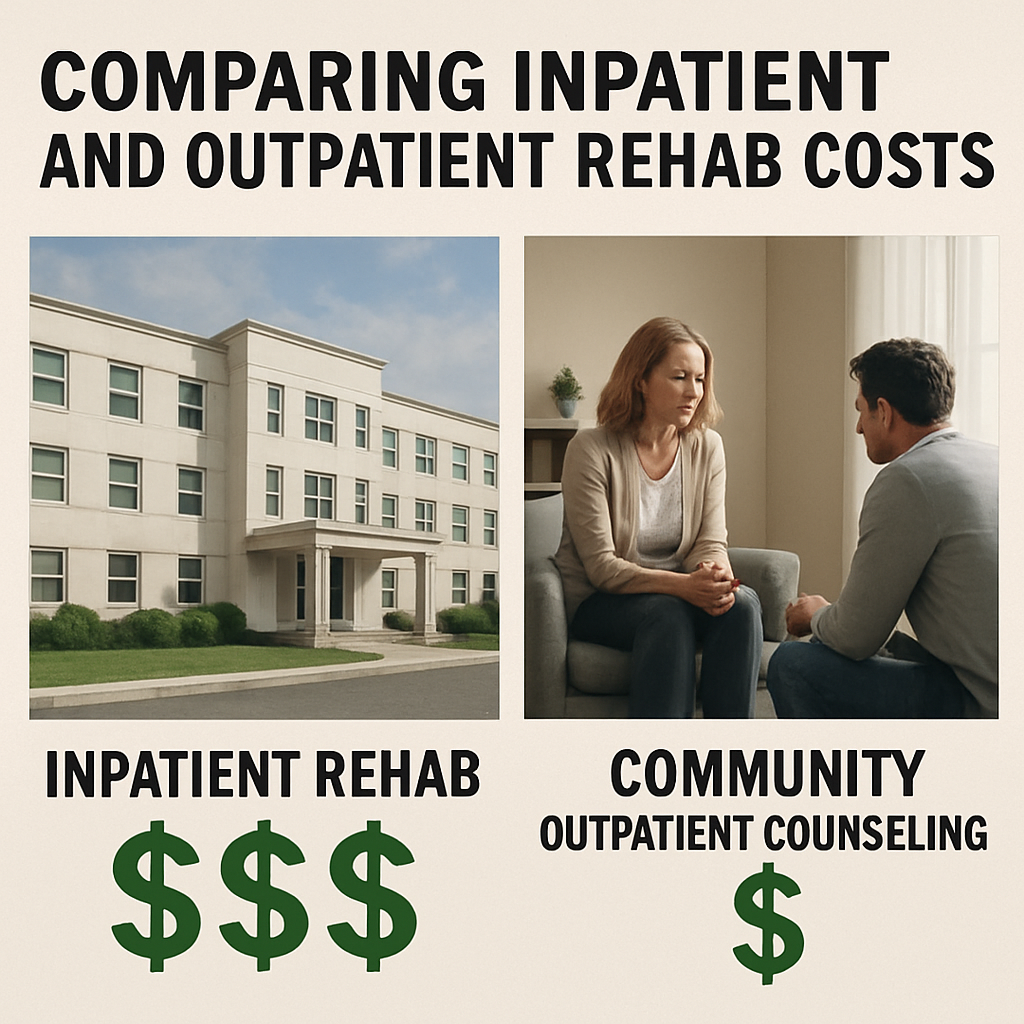
Comparing Inpatient vs Outpatient Rehab Costs
When you stare at the rehab cost estimate, the first question that pops up is usually, “Should I go residential or stay out‑patient?” It’s a classic dilemma because the numbers can look wildly different, but the right answer depends on more than just price.
What drives the price gap?
Inpatient programs are like a 24‑hour hotel with medical staff on call. You’re paying for a bed, meals, constant monitoring, and the ability to focus solely on recovery without the distractions of work or school. That all‑day, every‑day care pushes the per‑day cost up – often $300‑$500 or more.
Outpatient programs, on the other hand, rent a conference room a few times a week. You still get therapy, medication management, and group support, but you’re covering your own housing, food, and transportation. That’s why you’ll see a per‑week price in the low‑hundreds rather than the per‑day rates of residential care.
So, what should you look at first? The severity of the substance use disorder, any co‑occurring mental health issues, and the safety net you have at home.
Real‑world cost snapshots
Take the Martinez family in Riverside. Their 30‑day inpatient stay was quoted at $45,000. After insurance covered 60%, they faced $18,000 out‑of‑pocket. Because they lived with grandparents who could supervise, they later switched to a step‑down outpatient program for the next 60 days at $8,000 total, shaving $10,000 off the original plan.
Contrast that with the Patel family in Orange County, where the teenager needed intensive medical detox. The inpatient detox alone ran $5,500, but the subsequent 45‑day residential stay cost $38,000. Their insurance capped coverage at 30 days, leaving them with $12,000 to cover. They opted for a hybrid: 30 days inpatient, then a 12‑week outpatient IOP at $3,600, reducing the total out‑of‑pocket to $8,100.
These examples illustrate that the “cheapest” option isn’t always the best fit. You have to weigh the clinical need against the financial reality.
How to compare costs side‑by‑side
1. Ask for a day‑by‑day breakdown. Facilities should be able to tell you exactly what $X per day covers – bed, meals, nursing, therapy, labs.
2. Map each line item to your insurance benefits. Some plans treat detox as a separate benefit, while others bundle it with the residential stay.
3. Calculate the total “total cost of care.” Add up inpatient days, outpatient follow‑up, any medication‑assisted treatment, and after‑care such as sober‑living or outpatient counseling.
4. Factor in hidden expenses. Transportation, child‑care for siblings, and lost wages can add a few thousand dollars over the course of treatment.
Tips to keep the rehab cost manageable
• Negotiate a step‑down plan. Many centers will let you start with a short residential stay and then transition to outpatient – you get the intensive start you need without paying for weeks you don’t require.
• Ask about bundled therapy sessions. Some programs bundle family counseling into the overall fee, which can save you $200‑$300 per session.
• Check if the outpatient schedule fits your work life. Evening IOPs often cost the same as daytime sessions but let you keep a paycheck.
• Look into TRICARE or other government plans if you qualify. The TRICARE cost matrix shows that many outpatient services are covered with minimal copays, which can dramatically lower the out‑of‑pocket amount for veterans and their families.
Bottom line checklist
- Get a detailed, itemized estimate for both inpatient and outpatient options.
- Match each cost line to your insurance coverage or government benefits.
- Consider a hybrid approach – start inpatient, then transition to outpatient.
- Include ancillary costs: travel, child‑care, lost wages.
- Ask about bundled services and family therapy discounts.
Remember, the goal isn’t to pick the cheapest label; it’s to choose the level of care that gives your loved one the best chance at lasting recovery while staying within your budget.
Feeling stuck on the numbers? Call now (949) 545-3438 for a free cost‑analysis consultation. We’ll walk through the inpatient vs. outpatient math together and help you map a plan that works for your family.

Tips to Reduce Rehab Cost Without Compromising Care
Let’s be real: you’re staring at a rehab cost estimate and thinking, “How am I supposed to make this work without cutting corners on care?” You’re not alone. Most families feel that knot in their stomach the moment the numbers land.
Dig into the insurance fine print
Insurance isn’t just a black box that magically pays for everything. It’s a puzzle of pre‑authorizations, caps, and tiered co‑pays. Pull the itemized quote from the rehab center, then sit down with your case manager and ask, “Which line items are covered in full, and where do I hit a limit?”
Often you’ll discover that detox or lab work is covered 100%, while the nightly bed fee gets a 70% co‑pay after a 30‑day cap. Knowing that lets you swap a pricey “luxury” room for a standard one without sacrificing safety.
So, what should you do next? Grab a spreadsheet, list every charge, and color‑code the ones insurance will pick up. That visual cue becomes your bargaining chip.
Bundle services whenever you can
Many facilities sell therapy sessions, family counseling, and after‑care as separate line items. Ask them to roll those into a single package. A bundled family‑therapy discount can shave off $200‑$300 per session, and you’ll avoid surprise invoices later.
In our experience, families that ask for a “full‑service package” often get a modest reduction because the center saves on administrative overhead. It’s a win‑win.
Tap into financial assistance programs
Pharmaceutical manufacturers and nonprofit groups run assistance programs that can offset medication or even certain therapy costs. The same principle applies to rehab‑related meds. A quick search for medication assistance programs shows how you can qualify for reduced pricing by providing proof of income.
Don’t assume you have to pay full price. Call the drug’s manufacturer, ask your pharmacist, or use online tools to see if a coupon or grant exists. It’s a small phone call that can save you hundreds.
Consider home‑based or hybrid models
After the intensive phase, many families transition to a step‑down program that blends in‑home care with outpatient visits. Investing in a home phototherapy unit for a related condition, for example, can cost $5,000 upfront but drops yearly visit fees by $3,900. The math works out after two years.
Similarly, a hybrid rehab plan—30 days residential, then 12 weeks outpatient—can cut total out‑of‑pocket costs by 30% while still delivering the clinical intensity you need.
Negotiate payment plans or discounts
Never assume the quoted price is set in stone. Ask the billing department if they offer a 0% interest 12‑month plan, or whether a larger upfront payment nets you a 5%‑10% discount. Most centers have flexibility; they just need you to ask.
And here’s a tip that surprises many: some facilities will waive ancillary fees—like parking or transportation—if you sign up for a longer‑term after‑care contract. It sounds like a trade‑off, but the total savings often outweigh the extra commitment.
Keep track of every receipt
Every invoice, EOB (Explanation of Benefits), and payment confirmation should go into a simple spreadsheet. When you have a paper trail, you can appeal unexpected charges or request retroactive adjustments from your insurer.
Does this really work? Families who keep a tidy record have reported up to $2,000 in reclaimed costs simply by catching duplicate billing.
Bottom line: reducing rehab cost isn’t about cheapening care; it’s about being strategic, asking the right questions, and leveraging every resource you can find.
Ready to put these tips into action? Call now (949) 545-3438 for a free cost‑analysis consultation. We’ll walk you through the numbers, flag hidden fees, and help you build a sustainable plan that protects both your wallet and your loved one’s recovery.
Conclusion
We’ve walked through every piece of the rehab cost puzzle—from the headline bed fee to the hidden lab charge, from insurance quirks to financing hacks. By now you probably feel a little less overwhelmed and a lot more equipped to ask the right questions.
So, what’s the next step? Grab the itemized estimate you just asked for, line it up against your insurance benefits, and flag any surprises. Put those numbers in a simple spreadsheet—column for cost, column for coverage, column for notes. That visual map becomes your bargaining chip when you call the billing office.
Remember, most centers will bend on payment plans or discount bundles if you simply ask. A 0 % interest 12‑month plan or a modest upfront discount can shave thousands off the total. And don’t forget to track every receipt; families who keep a paper trail often reclaim $1‑2 K in duplicate charges.
At the end of the day, the goal isn’t just a lower rehab cost—it’s a sustainable plan that protects your loved one’s recovery while keeping your household afloat. You’ve got the tools, the checklist, and the confidence to move forward.
Ready to put it all together? Call now (949) 545-3438 for a free cost‑analysis consultation. We’ll walk you through the numbers, spot hidden fees, and help you build a realistic budget that works for your family.
FAQ
What is the typical rehab cost for a 30‑day residential program?
Most residential stays fall somewhere between $8,000 and $60,000 for a month, depending on location, amenities, and the level of medical monitoring. In Southern California, you’ll often see the higher end of that range because facility overhead is steep. Ask the center for a day‑by‑day breakdown so you can see exactly what each $100‑$200 per night covers – room, meals, nursing, therapy, and labs.
How much of the rehab cost does insurance usually cover?
Insurance can cover anywhere from 0% to 80% of the total bill, but it rarely pays the full amount. Most plans have a lifetime cap for substance‑use treatment and may only reimburse specific services, like detox or individual therapy. Grab an itemized estimate, then call your case manager and match each line‑item to your benefits. Knowing which charges are fully covered and which hit your pocket can save you a few thousand dollars.
Can I negotiate the rehab cost before I sign a contract?
Absolutely – many centers have hidden flexibility. In our experience, families who show a competitor’s quote or point out duplicate fees often get a modest discount or a bundled package that trims optional services. Ask directly about a 0%‑interest 12‑month payment plan, a sliding‑scale fee based on income, or a discount for paying a larger upfront amount. It never hurts to ask, and most billing offices expect it.
What hidden fees should I watch out for?
Beyond the headline bed fee, look for charges like transportation, parking, extra lab tests, and “premium” room upgrades. Some facilities bill family‑therapy sessions separately, even though they’re part of the overall treatment plan. Keep every invoice and compare it to your spreadsheet; a $200‑$300 surprise can appear as “ancillary service” if you don’t track it. Spotting these extras early gives you leverage to contest or negotiate them.
Is a step‑down or hybrid model a way to lower the overall rehab cost?
A hybrid approach starts with a short inpatient detox or residential stay, then moves to outpatient intensive‑outpatient (IOP) or sober‑living housing. This can shave 30%‑40% off the total out‑of‑pocket amount while still delivering the clinical intensity you need. Ask the center if they offer a “step‑down” plan and request a combined cost estimate so you can compare it side‑by‑side with a full‑duration stay.
How can I use a spreadsheet to keep rehab cost under control?
Create columns for “Category,” “Cost,” “Covered by Insurance,” and “Notes.” Fill in each line‑item from the estimate, then color‑code anything insurance won’t pay. Add a 5%‑10% contingency for unexpected labs or medication changes. When you see the numbers laid out, you’ll quickly spot overlaps, negotiate duplicate charges, and have a clear talking point for the billing office or your case manager.
What should I do if my out‑of‑pocket rehab cost is still too high?
First, call the center and ask about any available scholarships, community grants, or nonprofit sliding‑scale programs – many don’t advertise them unless you ask. Second, explore personal financing options like a low‑interest personal loan or a 0%‑intro credit‑card offer, but keep the payoff timeline short. Finally, if you’ve exhausted those avenues, give us a call now (949) 545-3438 for a free cost‑analysis consultation. We’ll walk through your estimate, flag hidden fees, and help you build a realistic budget that works for your family.


